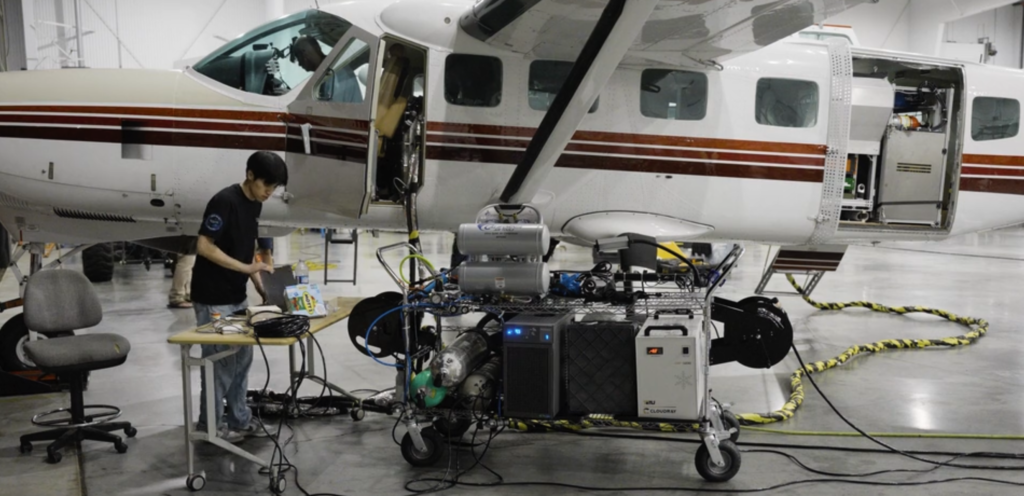
In November, a Cessna Caravan aircraft ascended to an altitude of 15,000 feet and fired an invisible near-infrared laser at ground-based solar panels, instantly illuminating the power readings on the dashboard. This experiment, conducted by startup Overview Energy, demonstrates that sending "sunlight from the sky" directly into the existing power grid is no longer just a laboratory paper, but a commercial plan that could potentially attract venture capital investment.
Near-infrared experiment at an altitude of five kilometers
Overview Energy's test was conducted over the southwestern desert of the United States. The aircraft circled continuously, and the laser beam, after passing through thin clouds, still struck a commercial polycrystalline silicon panel on the ground, outputting "several kilowatts" of power. According to Solar Daily , this marks the first time that "wireless power transmission," a long-standing focus of space-based solar energy, has been successfully implemented with usable power.
Overview Energy explains that the next step is to move the launcher to a low Earth orbit satellite so that the same laser can power ground-based solar panels at night.
Laser route and cost strategy
Compared to mainstream microwave solutions that require rectifier antennas covering several square kilometers, Overview Energy's biggest advantage is that "ground solar receivers do not need to be rebuilt."
Laser wavelengths are close to those of sunlight, allowing standard silicon substrates to absorb them directly. The company estimates that existing solar arrays with installed capacities of hundreds of gigawatts worldwide could see their capital utilization rate increase from approximately 25% to nearly 100% after lasers are integrated, with daytime illumination and nighttime laser radiation complementing each other.
This mindset attracted EQT Foundation and Lowercarbon Capital to participate in a $20 million seed round investment because it focuses spending on the space end and launch, avoiding the heavy costs of land and infrastructure.

Weather limitations and technological risks
However, near-infrared light attenuates dramatically when exposed to thick clouds or heavy rain, potentially reducing transmission efficiency to zero. This exposes the technology originally designed to address the intermittency of solar energy to the risk of downtime caused by climate change.
Furthermore, the information released by Overview Energy to date only mentions "tens of kilowatts" of instantaneous output, leaving gaps in end-to-end efficiency, beam jitter control in turbulence, and high-frequency safety shutdown mechanisms. For a startup that plans to launch a low-Earth orbit satellite in 2028 and begin commercial power supply in 2030, these physics and engineering challenges will directly impact capital requirements and mass production schedules.
Next stop: Space and market validation
U.S. government agencies are also assessing the feasibility. The Defense Advanced Research Projects Agency (DARPA) completed an 8.5-kilometer ground-to-ground laser transmission demonstration this summer, showcasing its dual-use potential. Meanwhile, China has chosen to build a large-scale microwave power station in geostationary orbit at an altitude of 36,000 kilometers, embarking on a large-scale national infrastructure development path.
The two strategies are reminiscent of the mainframe vs. personal computer debate in the internet age: should one pursue a single point of all-weather power supply, or break through with distributed, small, and rapidly iterating optical systems? At this stage, the market is still unable to draw a conclusion.
But Overview Energy's experiment proves at least one thing: space-based power generation doesn't have to wait for massive, unfinished power plants; there are already pathways to integrate with ground-based assets. If it can maintain stability in variable atmospheres and prove that it can generate positive cash flow even on clear nights, every silicon wafer in global installations could potentially be revalued.
Whether this laser beam can penetrate the clouds and overcome investor concerns will determine whether it can truly usher in a new 24-hour chapter for the renewable energy market.